 NEWS
Robotics · Humanoids
Schunk renames robot hand unit Tactilia, taps ex-Rolls-Royce exec as CEO
Schunk, the German maker of robotic grippers, has renamed its humanoid robot hand subsidiary Tactilia Robotics, the company announced on 18 November. The spin-off, founded in January, has been run since 1 November by Markus Netzer, who previously headed high-precision manufacturing at Rolls-Royce Solutions. The announcement gives no investment figure and no launch date for the hand.
Researched and drafted with AI support, directed and edited by Manfred Lugmayr; facts checked against the sources. How we work
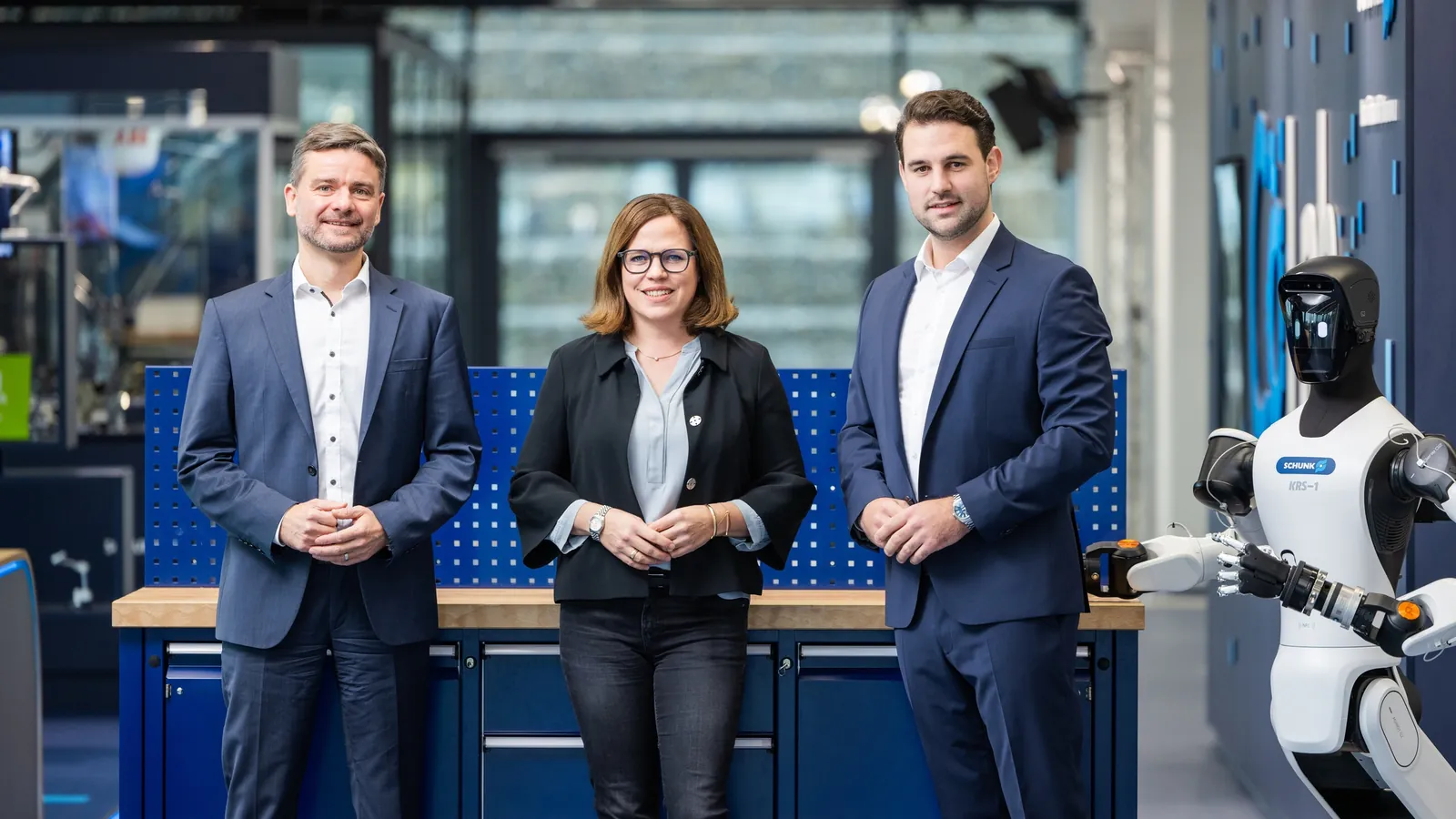
SCHUNK Humanoid Robotics GmbH now operates as TACTILIA Robotics GmbH, according to the press release. The name comes from the Latin “tactilis” and refers to the sense of touch. The company is based in Munich's Arabellapark business district, the release said. Netzer and Schunk chief executive Kristina Schunk unveiled the new name at the group's headquarters in Lauffen am Neckar, near Heilbronn. Austrian outlet Trending Topics also covered the change.
Humanoid robots have become good at seeing, understanding and moving but still often struggle to grasp objects, the company said. Tactilia is developing a modular robot hand for production and logistics that can pick up and position a wide range of parts. It is meant to work regardless of robot type, on humanoids as well as on cobots and mobile manipulators, combining mechanics, actuators, sensors, physical AI and software.
“The robot arm changed industry. The robot hand will do the same,” Netzer said in the release (all quotes translated from German), adding that the technology should come from Europe. According to the release, he ran high-precision manufacturing with more than 300 staff as Vice President Manufacturing at Rolls-Royce Solutions in Friedrichshafen. He holds a doctorate on AI in production from the Karlsruhe Institute of Technology and teaches production management at Aalen University.
What Schunk brings
Tactilia operates as an independent company but draws on its parent's infrastructure, including 15 Schunk application centres, called CoLabs, around the world where customers can test the hand on real tasks, the release said. Kristina Schunk described the goal as “a robot hand that proves itself in practice”, according to the release. Schunk's chief technology officer, Timo Gessmann, said robot hands must be “easy to integrate and reliable in continuous operation”.
When it set up the unit in January, Schunk said it would develop the next generation of a modular five-finger hand with an integrated wrist and forearm, and that a new prototype was close to being ready for use. Its stated ambition is a global standard for humanoid hands. In June, Schunk and Robert Bosch Robotics GmbH also announced a development partnership for an industrial-grade hand that can be fitted to different humanoid systems, German trade title Logistik Heute reported. The latest announcement does not say what role Tactilia plays in that project.
Tactilia also faces venture-backed start-ups working on robotic grasping and touch in Germany, Austria and Switzerland. Zurich-based Enact Intelligence, which wants to give robots a sense of force and touch, raised $30m in a pre-seed round in October, Trending Topics reported, with backing from Zurich investor redalpine among others.
Analysis
At the Swiss Robotics Day in Zurich, many of the new products were hands, sensor skin and joint actuators, I4U News reported. While humanoid software increasingly runs on Nvidia's platforms, these components were described there as the bottleneck. For a component supplier such as Schunk, the hand is likely the part of the robot where it can still capture value when the software comes from Nvidia. Tactilia's main advantage is access to 15 application centres where customers can try the hand on their own parts. A start-up like Enact still has to win that kind of access through pilot customers.
What remains unclear is how much Schunk is putting in. Enact raised $30m in its first round alone; whether Schunk is giving its unit comparable resources is unknown. Nor is it clear whether Tactilia and the Bosch project are building the same hand or rival ones. Tactilia will be judged on a date for its first production hand and on customers running it in continuous operation.
The facts
- SCHUNK Humanoid Robotics GmbH has operated as TACTILIA Robotics GmbH since 18 November 2026, based in Munich.
- Markus Netzer, formerly Vice President Manufacturing at Rolls-Royce Solutions, has been CEO since 1 November 2026.
- The modular hand targets humanoids, cobots and mobile manipulators in production and logistics.
- Customers can test it in 15 Schunk CoLabs worldwide.
- In June 2026 Schunk and Robert Bosch Robotics also announced the joint development of an industrial robot hand.
Questions and answers
What is Tactilia Robotics?
Tactilia Robotics is the former SCHUNK Humanoid Robotics GmbH, a spin-off founded in January 2026 by German gripper maker Schunk. Based in Munich, it develops robot hands for humanoid robots, cobots and mobile manipulators.
Who runs Tactilia?
Markus Netzer has been CEO since 1 November 2026. He was previously Vice President Manufacturing at Rolls-Royce Solutions in Friedrichshafen, Germany.
Does Tactilia have outside investors?
The 18 November announcement names no outside investors and no investment amount. According to the release, Tactilia operates as an independent subsidiary of Schunk.
Sources
- TACTILIA Robotics (press release): SCHUNK-Spin-off für humanoide Roboterhände wird zu TACTILIA Robotics (18 Nov 2026) primary source
- SCHUNK (press release): SCHUNK establishes technology spin-off for humanoid robot hands (2026-01) primary source
- Trending Topics: TACTILIA: Schunk-Spin-off baut Roboterhand für Humanoide (19 Nov 2026) independent source
- Logistik Heute: Kooperation: Schunk und Bosch entwickeln gemeinsam humanoide Roboterhände (18 Jun 2026) independent source
- Trending Topics: Enact: 30 Millionen Dollar Pre-Seed für Roboter mit Tastsinn (22 Oct 2026) independent source