 NEWS
Robotics · Humanoids
Humanoid robots: Nvidia supplies the brain, DACH builds the hand
The software for humanoids is turning into an Nvidia standard. What's scarce is everything that grips: hands, actuators, sensors. That's where Germany, Austria and Switzerland are strong, except that many of the big new customers are in China.
Researched and drafted with AI support, directed and edited by Manfred Lugmayr; facts checked against the sources. How we work
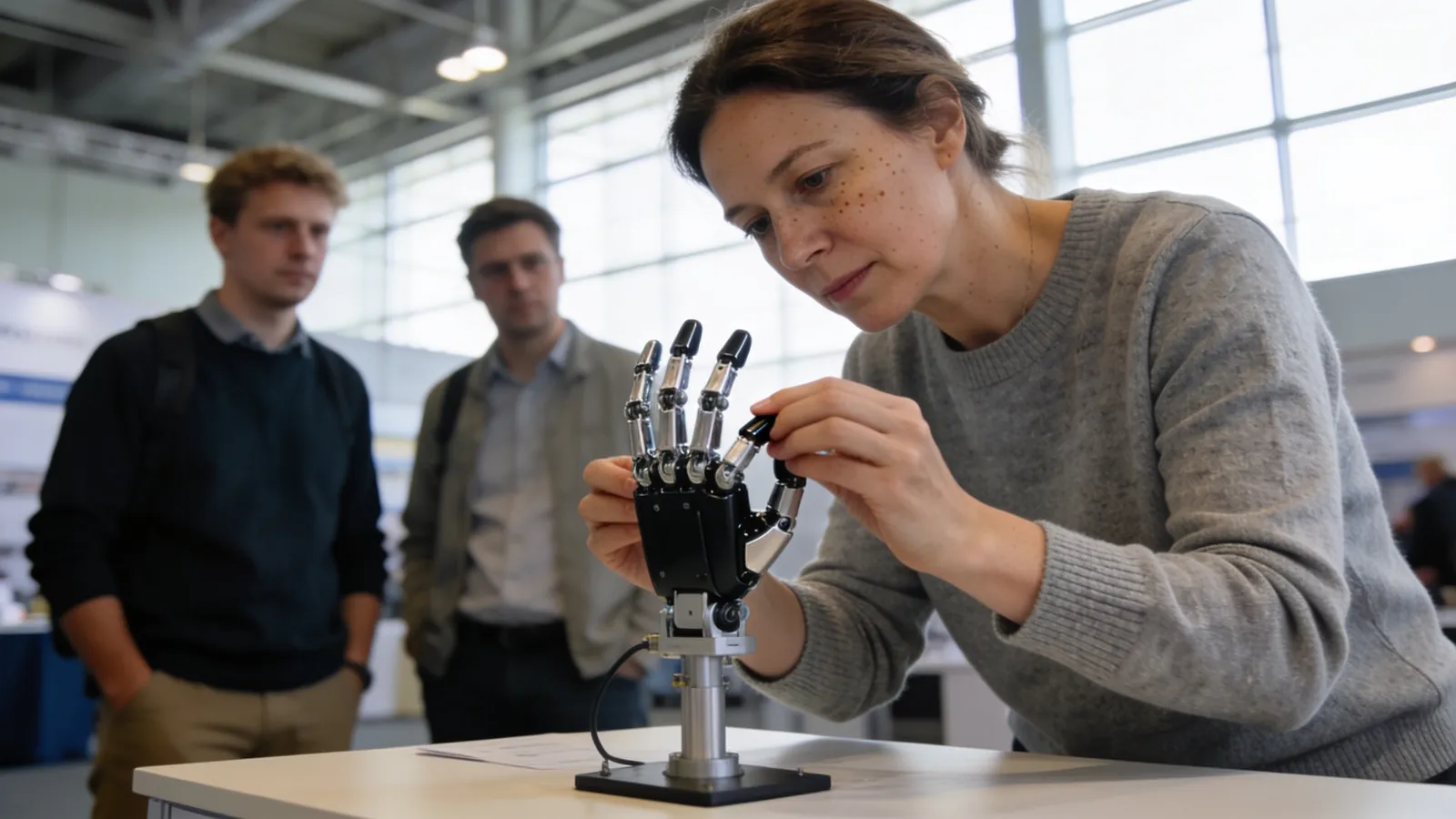
1,404 visitors from 35 countries, 103 exhibitors, Unitree, Nvidia and Agile Robots on stage: Swiss Robotics Day in Zurich-Oerlikon sold out on Friday. Read through the trade-show reports, though, and something else stands out. A surprising number of the launches weren't about whole robots at all, but about fingers, skin and joints.
Sounds like supplier small print. It isn't. For me, it's the real robotics story of the week from Germany, Austria and Switzerland.
What was on show in Zurich
The event was organised by ETH Zurich RobotX with support from the Swiss Robotics Association. According to an on-site report (translated by Bytes Europe), Aude Billard, head of the EPFL Robotics Center, named dexterous manipulation as the hurdle to real-world deployment. Her team spent five years studying how people use their hands and apply pressure, for example in watchmaking. Her point: understanding how humans learn fine motor skills gets you further than ever-larger motion datasets.
Alongside that, the hardware, all according to the manufacturers:
- Sonceboz showed a hand that drives 16 of its 20 degrees of freedom itself and delivers up to 40 newtons at the fingertips, plus actuators under 50 grams with up to 1.5 newton-metres.
- Inveel presented a 500-micrometre-thin “robot skin” that detects objects up to 15 centimetres before contact.
- Bota Systems launched TACTO, a platform that bundles force, touch, camera and robot data for AI training.
And a Korean supplier pushing into joint drives summed it up: actuators are the heart of the robot and a large share of its cost.
The brain is becoming standard
Why that matters becomes clear if you look back four weeks. At GTC Berlin, Agile Robots unveiled its Agile ONE SN reference humanoid, built on Nvidia's Isaac GR00T and Jetson Thor. In the same Nvidia announcement: Neura, Sereact and Franka all work with Nvidia tooling. In other words, a good part of Germany's robotics elite is building on the same software stack. (Agile, incidentally, has just raised $500m at an $8.5bn valuation.)
My rule of thumb from the software business: code is no longer a moat. Whatever can be copied will be. In robotics, that means to me: if the brain comes off the shelf, the body decides. And in the body, the hand is the hardest part. That happens to be exactly where the region is strong, from Swiss precision engineering to Schaeffler.
The second-order point: who is buying the hand?
Schaeffler is the test case. According to COO Jochen Schröder, its order intake in humanoid robotics stands at around €400m, components have gone into more than 80 projects, and two new customers from Greater China were added in the third quarter (Börsen-Zeitung, 20 Oct). Its new Lighthouse Factory is in Taicang near Suzhou: there, six humanoids at five stations assemble actuators for future humanoids. At the same time, Schaeffler is cutting 3,460 jobs in Europe by 2028, around 2,660 of them in Germany.
That isn't a scandal; it's a supply chain. But it shows the direction of travel. The region builds the heart, and many of the big new customers for it are in China. Who wins? Whoever owns the component and gets designed into many platforms early. Who pays? The sites that were hoping for final assembly.
The catch
Components are a price game. The Korean supplier said openly that finding vendors who hit both the spec and the price is hard. Asian manufacturers are pushing into exactly that gap. And Schröder himself doesn't yet expect a significant earnings contribution from robotics. The €400m is order intake, not profit.
What I would do now
- Founders: Don't pitch “yet another humanoid”; pitch the bottleneck. If you build hands, skin or actuators, aim early for design-ins across several platforms, as Schaeffler has done with Hexagon and Leju.
- Investors: Ask in every due diligence: which part of the stack does the startup still own once Nvidia supplies the brain?
- Industry: In every humanoid pilot, find out who supplies the actuators and hands, and from which country. That's your supply chain for the next few years.
Bottom line: The brain for humanoids will soon come off the shelf, the hand won't, and whoever builds it decides where the value ends up.
The facts
- Swiss Robotics Day, 13 Nov 2026 in Zurich: 1,404 visitors from 35 countries, 103 exhibitors, organised by ETH Zurich RobotX.
- Sonceboz showed a robot hand with 16 of 20 degrees of freedom actuated and up to 40 N at the fingertips (manufacturer figures).
- Schaeffler: around €400m order intake in humanoid robotics, more than 80 projects, two new customers from Greater China in Q3.
- Schaeffler is cutting 3,460 jobs in Europe by 2028, around 2,660 of them in Germany.
Questions and answers
What is Swiss Robotics Day?
A robotics trade show and conference in Zurich, organised by ETH Zurich RobotX with the Swiss Robotics Association. In 2026, according to the organisers, 1,404 visitors from 35 countries came to see 103 exhibitors.
How does Schaeffler make money from humanoid robots?
Mainly with components such as linear and rotary actuators for joints. According to COO Jochen Schröder, order intake is around €400m; a significant earnings contribution isn't expected yet.
Sources
- Swiss Robotics Day (organiser): SRD26 – Swiss Robotics Day 2026 (13 Nov 2026) primary source
- Nvidia Newsroom: NVIDIA Advances Isaac Platform for General-Purpose Robotics With New Reference Humanoid, Frameworks, Simulation Pipelines and Data (21 Oct 2026) primary source
- Bytes Europe: Swiss Robotics Day spotlights dexterous manipulation, tactile sensors, and Korea-Switzerland partnership talks (14 Nov 2026) independent source
- Börsen-Zeitung: Schaeffler-Vorstand: „Robotik ist unser vielversprechendstes Wachstumsfeld“ (20 Oct 2026) independent source
- Robotics & Automation News: Schaeffler opens lighthouse factory in Taicang where humanoids will make humanoids (26 Oct 2026) independent source
- Trending Topics: Schaeffler: Stellenabbau und Robotik (3 Nov 2026) independent source