 NEWS
AI · Defence AI
Helsing Clarity: own the battlefield picture, control the contracts
With Clarity, Helsing wants to become the data platform for European armed forces, a sovereign alternative to Palantir's Maven. Whoever owns that layer helps decide which sensor is heard and which weapon is proposed. For defence startups in the region, that matters more than any drone.
Researched and drafted with AI support, directed and edited by Manfred Lugmayr; facts checked against the sources. How we work
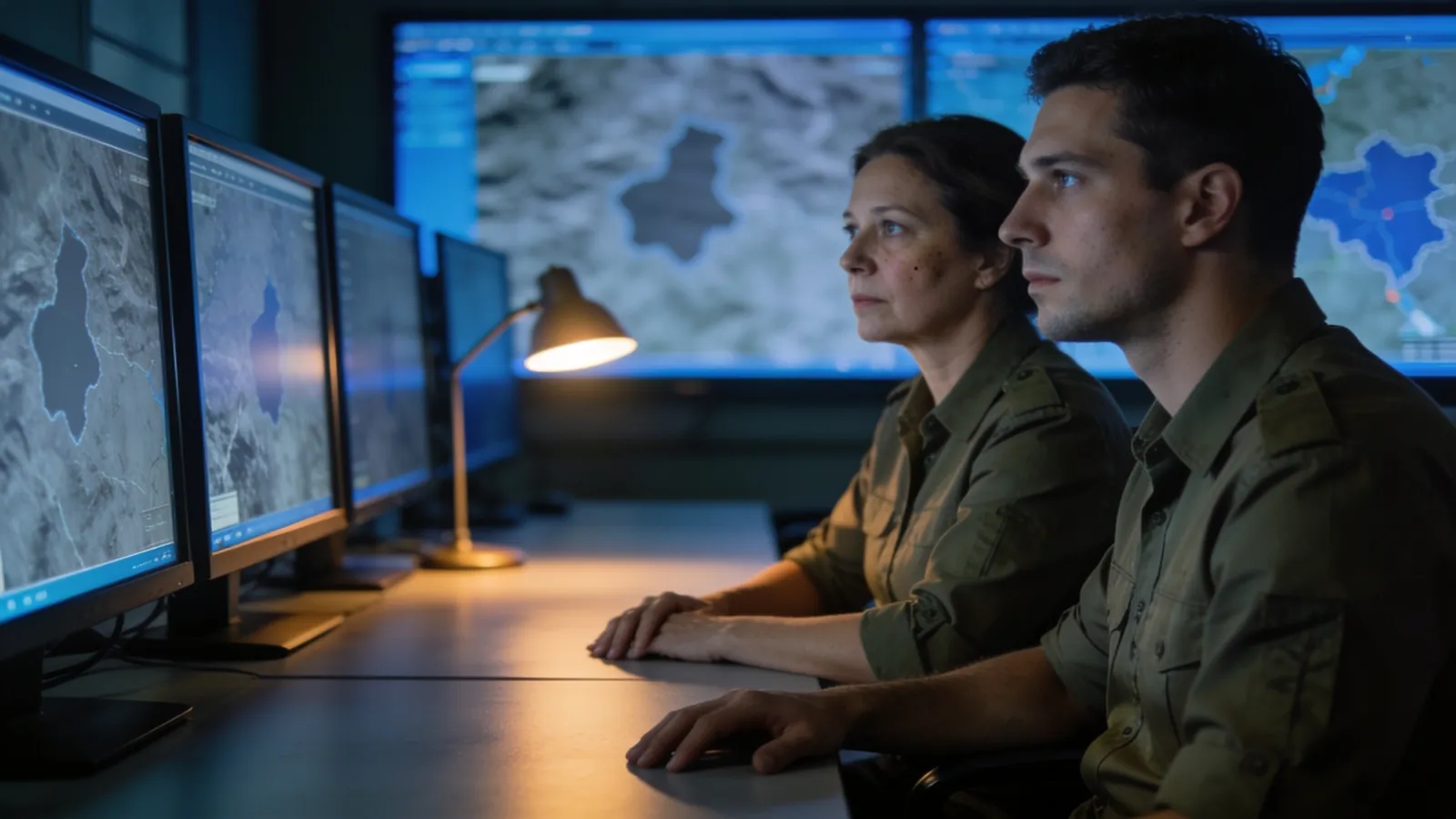
You know the moment in a large organisation when the best supplier no longer wins, and the one already inside the system does? That moment is what Helsing is chasing right now. Not drones. The battlefield picture.
On 11 November, the Munich defence startup unveiled Clarity in Berlin. Helsing calls it an “agentic intelligence platform”: hundreds of specialised AI agents analyse satellite imagery, drone video, sensor data, open sources and written reports in parallel, identify enemy systems and prepare the data for “the most suitable weapon”. A human reviews the evidence, selects every target and approves every hand-off to a weapon system. Each decision is logged with the name of the person who made it. Clarity runs on the customer's own infrastructure, follows NATO standards and the MOSA principle, and is meant to connect to weapons from any manufacturer. All of this is according to Helsing.
The rival is named outright: Palantir's Maven Smart System, which Reuters describes as the market leader, firmly embedded in Pentagon and NATO workflows. Co-CEO Gundbert Scherf: “A capability this critical must be sovereign.”
The product isn't the AI. The product is the interface.
It sounds like the next sovereign-AI pitch. It isn't quite. What I find interesting is that Helsing is selling the layer everything else runs through. Whoever supplies an army's data platform defines the ontology, the data formats and the interfaces. And with them, which sensor gets heard and which effector ends up in the recommendation.
That is the Palantir playbook, and it's the reason for Palantir's valuation. Models get copied quickly. A position in the workflow does not. My rule of thumb from the software business applies one to one: your code is no longer a moat, your distribution is. In defence, distribution means accreditation, integration and the trust of the troops.
The timing is no accident. According to Werra-Rundschau (Ippen Media), Vice Admiral Thomas Daum, head of the Bundeswehr's Cyber and Information Domain Service, rejected Palantir for the military AI cloud in April. Germany's armed forces are evaluating around 30 AI tools, most of them German, and want to introduce their own system from 2027, fully rolled out in 2028. Der Spiegel, cited by Börsen-Zeitung and Werra-Rundschau, reports that Clarity is already being tested by the Bundeswehr. That isn't a contract. It is a foot in the door.
The second-order point: platform and weapons maker in one company
This is where it gets interesting for founders and investors in Germany, Austria and Switzerland. Helsing isn't just software. On 26 October it presented Contra, an autonomous air-defence system, along with the AD-1 Inferno and AD-2 Ambush interceptors, on top of the drones it supplies to Ukraine. When the same company provides the platform that prepares “the most suitable weapon” and also sells weapons, you have a textbook gatekeeper conflict. Once agents are in the loop, every product gets compared. The only question is who writes the criteria.
For the many smaller defence-tech startups between Munich and Zurich, that means: your route to the customer may soon run through a platform layer owned by a competitor. “Open to effectors from all manufacturers” is a promise. It only becomes a contractual obligation when the procurement office demands it.
And for investors: Helsing raised $1.8bn in a Series E in July at an $18bn valuation. In my view, Clarity is an attempt to earn the economics of a platform company rather than those of a defence contractor. Whether that holds will be decided not by the demo in Berlin, but by the Bundeswehr's tender.
The catch
Helsing names no customer and no deployment date. Clarity hasn't been proven in a real operation; Maven has. And “human in the loop” is only as good as the time the human gets. The Decoder points to reporting by +972 Magazine that, at times, the review of each target in Israel's Lavender system took around 20 seconds. A log with a name on it shifts responsibility to the operator. It doesn't guarantee a thorough review. The platform can only be as clean as the process the army builds around it.
What I would do now
- As a defence-tech founder: Build and document interfaces to NATO standards and MOSA now. Don't bet on one platform; make sure you can plug into any platform that might win in 2027.
- As an investor: In every due diligence, ask which platform the product reaches the customer through, and who owns that interface.
- As an industrial partner or procurement officer: Write open interfaces and the separation of platform and effector roles into the contract before the first prototype runs.
Bottom line: In defence AI, the smartest model doesn't win; whoever owns the battlefield picture does, because they decide whose weapon gets proposed.
The facts
- Helsing unveiled Clarity in Berlin on 11 Nov 2026: AI agents analyse sensor, image and text data in parallel.
- According to Helsing, a human approves every target and every hand-off to a weapon, and each decision is logged by name.
- The Bundeswehr isn't buying Maven for now and is evaluating around 30 AI tools for its own system from 2027, fully rolled out in 2028.
- Helsing names no customer or deployment date; according to Der Spiegel, the Bundeswehr is testing Clarity.
- Helsing raised $1.8bn in a Series E in July 2026 at an $18bn valuation.
Questions and answers
Does the Bundeswehr use Helsing Clarity?
There is no contract. According to Der Spiegel, cited by Börsen-Zeitung and Werra-Rundschau, the Bundeswehr is testing Clarity. Helsing itself names no customer.
Why isn't the Bundeswehr buying Palantir's Maven?
According to Werra-Rundschau, Vice Admiral Thomas Daum rejected Palantir for the military AI cloud in April. The Bundeswehr wants to introduce its own system from 2027 and is evaluating around 30 AI tools for it.
Sources
- Helsing (press release): Helsing unveils Clarity, a sovereign software platform for military intelligence (11 Nov 2026) primary source
- Helsing (press release): Helsing raises US$1.8bn in Series E (13 Jul 2026) primary source
- Werra-Rundschau (Ippen): München gegen Palantir: Helsing greift nach Europas Kriegs-KI-Daten (13 Nov 2026) independent source
- Börsen-Zeitung: Helsing will Palantir mit Gefechts-KI Konkurrenz machen (11 Nov 2026) independent source
- The Decoder: Helsings neue KI-Plattform Clarity soll Europas Antwort auf Palantirs Maven werden (11 Nov 2026) independent source
- The Next Web: Helsing launches Clarity, a European rival to Palantir's Maven (11 Nov 2026) independent source